AI agents are already doing real work
There is a shift happening right now that is hard to overstate. AI agents are not a future concept. They are running today, inside tools like Claude, in automated pipelines, in codebases that call external APIs to get market data, generate reports, check inventory, or translate documents.
These agents do not browse a website and fill out a form. They send HTTP requests. They get back data. They move on to the next task. The whole loop can happen in seconds, and there is no human clicking anything.

The problem that keeps getting overlooked
Here is what most people building APIs have not figured out yet: AI agents cannot set up a billing account. They cannot enter a credit card number. They cannot sign up for a free trial, verify their email, and wait for access approval. Every one of those steps requires a human.
So what happens in practice? API owners either make their endpoint free and get hammered with usage they did not plan for, or they lock it behind manual key creation and watch the agents hit a wall and fail. Neither of those is good.
The missing piece is a way to charge per request, automatically, without any human in the loop. The agent hits your API, pays the fee, and gets access. That is it.
The core problem: APIs are built for human-registered accounts. AI agents do not have accounts. They have wallets. DropPay bridges that gap.
Why XRP is the right fit for this
Not every blockchain can handle per-request micropayments. Most have transaction fees that make a $0.50 API call impractical, settlement times that stretch to minutes, and confirmation complexity that breaks the synchronous request-response flow an API depends on.
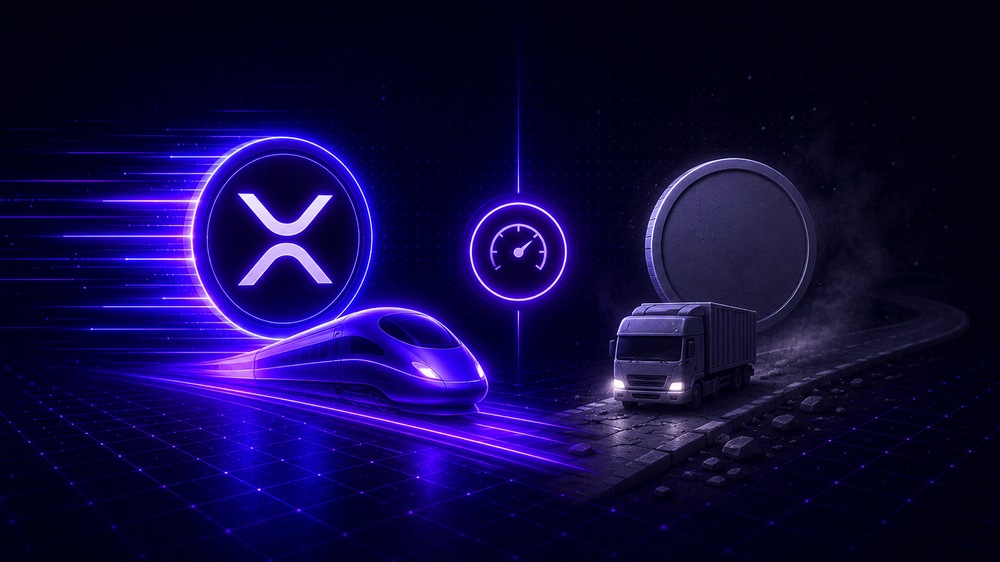
The XRP Ledger was designed differently. Transactions confirm in 3 to 5 seconds. Fees are a fraction of a cent. There is no mining, no waiting, no unpredictable gas spikes. For a payment that needs to happen inside a single HTTP exchange, those properties matter enormously.
XRP is not new to speed. What is new is the combination of that speed with the emergence of agents that actually need to use it.

Accept Ripple USD, a regulated dollar-pegged stablecoin, directly to your wallet. No volatility. No conversion. Dollar value settled on the XRP Ledger in seconds.
How DropPay is solving this
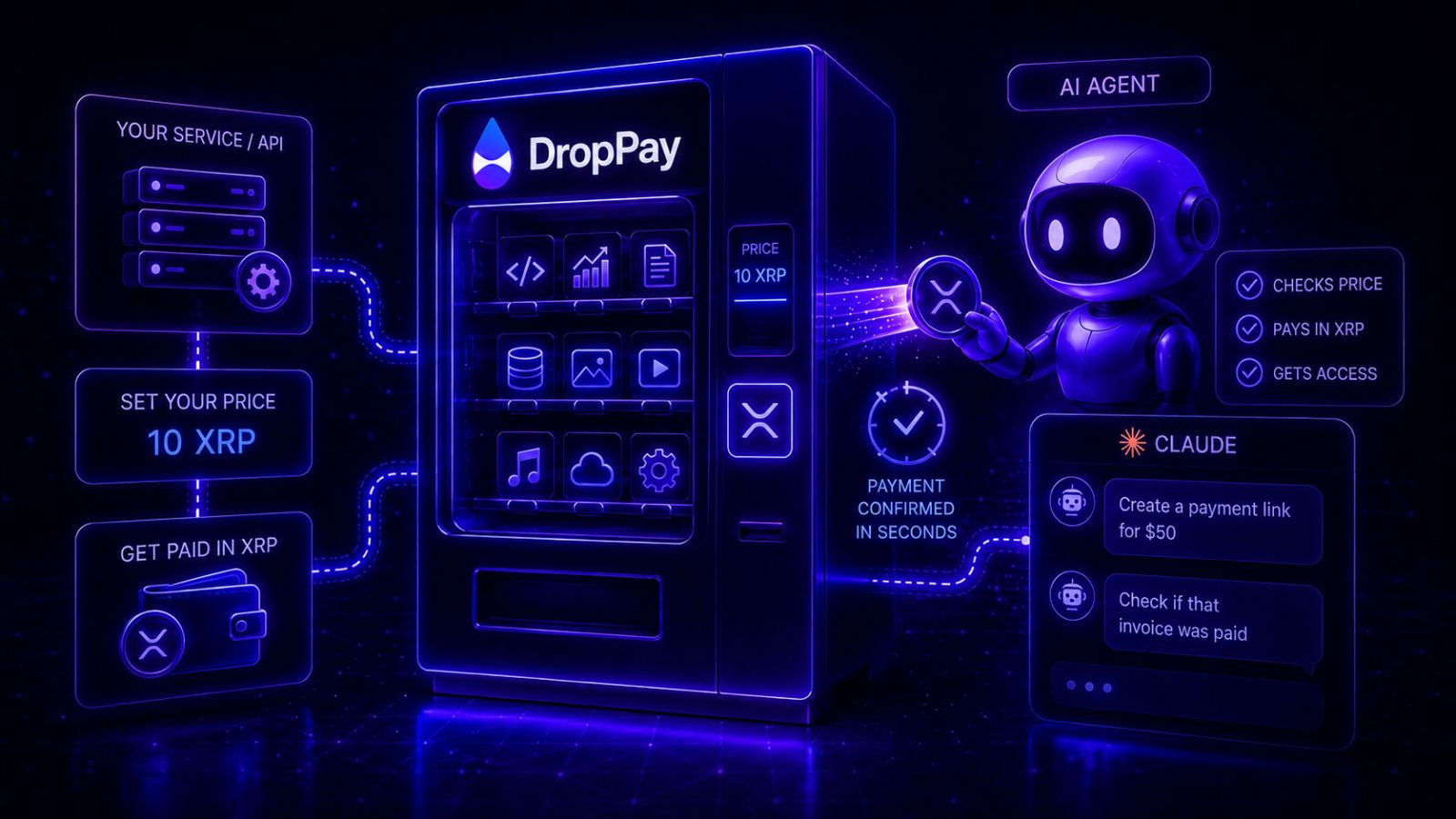
Think of it like a vending machine. You put a price on your service, the AI agent sees that price, drops the coins in, and gets what it needs. No one has to be standing there to take the money. No one has to send an invoice. The machine handles it.
DropPay is that machine. Your service sets the price once. When an AI agent comes knocking, DropPay tells it what the cost is and where to send the XRP. The agent pays directly to your wallet in seconds. DropPay checks that the payment landed on the XRP Ledger, then waves the agent through. The whole thing happens faster than you can blink.
There are two ways to use it, depending on what you are doing.
If you own a service or API. You put DropPay in front of your service and set a price. That is it. Any AI agent that wants access pays in XRP, automatically, every time. The money lands in your wallet. You never touch a billing system or approve a single transaction.
If you use Claude as your AI assistant. DropPay connects directly to Claude, so you can say "create a payment link for $50" or "check if that invoice was paid" right inside your conversation. Claude handles it. No new tab, no dashboard, no copy-pasting links.
A note on x402: x402 is the name of the open standard that makes this vending machine behaviour possible. It is a simple agreement between an AI agent and a service that says "if you send me a payment on XRP, I will let you through." Ripple helped define it as part of the XRPL AI Starter Kit, and DropPay is built on top of it. You do not need to understand the spec to use DropPay. But if you are curious, that article is the best place to start. For developers: one line of middleware in FastAPI or Flask is all you need. See the docs.
How agents actually pay, step by step
Here is the full sequence, in plain terms:
It tries to use your service, the same way it would call any website or tool.
Instead of letting it in, DropPay sends back the cost and your XRP wallet address. Think of it as a sign on the door saying "entry costs 1 XRP, send it here."
It sends the XRP directly to your wallet on the XRP Ledger. Confirmed in seconds. No intermediary holds the money.
DropPay verifies the payment landed on-chain, then lets the agent through. It gets what it came for. You get paid.
From your side: you set a price once, add the middleware, and the payments arrive in your wallet automatically. No invoices. No chasing. No payment processor.
Trust and verification in an agent-driven world
One of the real concerns people raise about AI agents is: how do you know what happened? How do you verify that a payment was made, or that a transaction is legitimate, and not just a claim?
Because DropPay uses the XRP Ledger, every payment is anchored on a public, immutable blockchain. The transaction hash is proof. Anyone can verify it. There is no trust required between the agent and the API owner because the ledger is the third party.
This is different from traditional payment systems where verification means calling a bank API, waiting for a webhook, or checking a database. With XRP, the proof is the ledger entry itself.
Every DropPay transaction is verifiable on-chain. The transaction hash is returned with each payment confirmation. You can check it on any XRPL explorer at any time, independently of DropPay.
Who this is built for
Agentic AI payments are useful across a wider range of situations than it might initially seem.
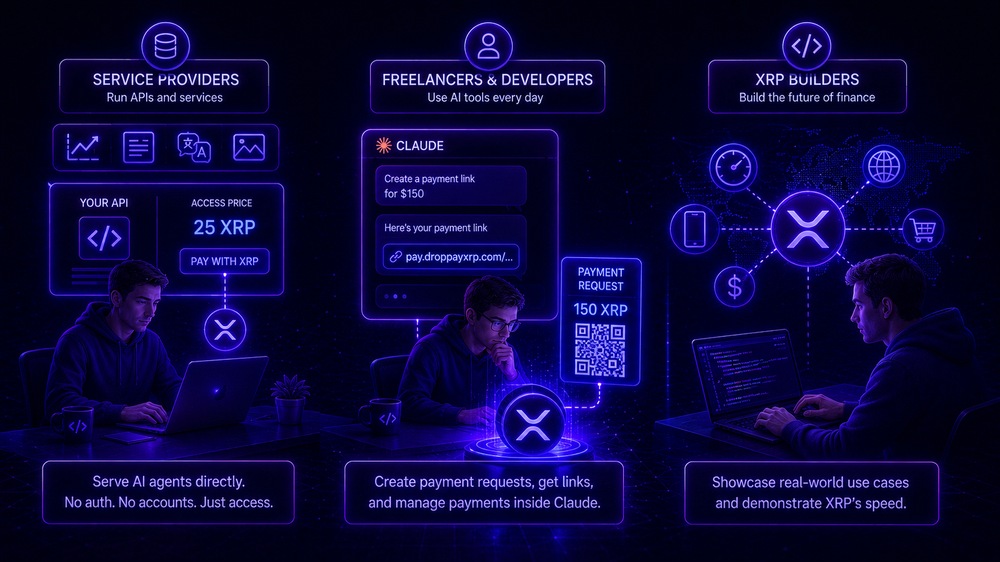
If you run a data API, a content API, a translation service, an image generator, or any other service that currently requires account signup to access, you now have a path to serve AI agents directly without building any auth infrastructure for them. The developer guide walks through the exact middleware setup for FastAPI and Flask.
If you are a freelancer or developer using AI tools daily, the MCP integration means DropPay is available inside your Claude workspace. You can create a payment request, get the link, and share it with a client without leaving the conversation you are already in.
If you are building with XRP and looking for ways to demonstrate what the network can do in practice, agent micropayments are one of the clearest real-world examples of XRP operating at its design speed.
Getting started today
Everything described in this post is live. No waitlist, no beta access, no special plan required to get started.
To enable x402 on your API, you need a free DropPay account and an XRP wallet address to receive payments. The setup guide in the docs walks through the full configuration in under 10 minutes. For a code-first walkthrough, the developer guide to x402 covers FastAPI and Flask middleware in detail, and the API and webhooks post shows how to handle the full payment lifecycle.
To connect DropPay to Claude Desktop via MCP, the connection config is available in your dashboard once you have an account.
The droppay-x402 Python package installs with pip and works with any FastAPI or Flask application. No custom XRPL node required.
If you are new to XRP wallets, Xaman is the most widely used wallet in the XRP community. It is free, available on iOS and Android, and handles both sending and receiving XRP.
Create a free account and enable x402 in under 10 minutes.
Get started free